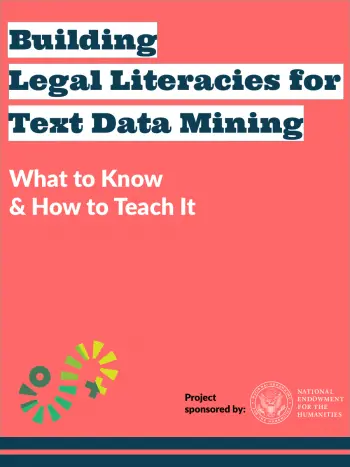
Authors: Beth Cate, Brandon Butler, Brianna L. Schofield, Courtney Glen Worthey, David Bamman, Maria Gould, Megan Senseney, Scott Althaus, Thomas Padilla
Text data mining has transformed how I approach research, policy analysis, and digital scholarship. Yet every time I work with large corpora—whether newspapers, books, social media archives, or research databases—I face a critical question: Is this legally permissible?
That’s exactly where Building Legal Literacies for Text Data Mining becomes essential reading. Written by Beth Cate, Brandon Butler, Brianna L. Schofield, Courtney Glen Worthey, David Bamman, Maria Gould, Megan Senseney, Scott Althaus, and Thomas Padilla, this work helps researchers, librarians, and educators understand how to responsibly and confidently navigate copyright, licensing, and ethical issues in computational research.
In this blog, I’ll walk through why legal literacy matters in text data mining (TDM), what core principles the book emphasizes, practical applications, and how it empowers scholars and institutions to move forward responsibly.
Why Legal Literacy Matters in Text Data Mining
When I conduct text analysis or build a corpus for computational linguistics research, I’m not just handling data—I’m interacting with intellectual property. Legal uncertainty can slow down or completely halt innovation.
Text data mining often involves:
-
Copying large volumes of text
-
Transforming copyrighted works
-
Storing temporary or permanent datasets
-
Sharing derived outputs
Without legal literacy, researchers either take unnecessary risks or avoid valuable research altogether. This book bridges that gap by clarifying how copyright law, fair use, and licensing frameworks apply to digital scholarship.
Understanding the Core Idea: What Is Legal Literacy?
Legal literacy doesn’t mean becoming a lawyer. It means understanding:
-
Basic copyright principles
-
How fair use applies to text mining
-
What licenses permit or restrict
-
Institutional risk management practices
-
Ethical data stewardship
When I improved my understanding of these concepts, I noticed I could design projects more efficiently and collaborate more confidently with librarians and legal teams.
Key Themes in Building Legal Literacies for Text Data Mining
1. Copyright and Fair Use in Computational Research
One of the most important discussions in the book revolves around fair use. Many text mining activities involve copying content for non-consumptive purposes (analysis rather than reading or redistribution).
The authors explain how courts have recognized transformative uses—such as search indexing and data analysis—as potentially qualifying for fair use under certain conditions.
For researchers, this clarity is empowering. Instead of guessing, we can evaluate:
-
Purpose of use
-
Nature of the work
-
Amount used
-
Market impact
Understanding these four factors helps structure projects responsibly.
2. Licensing Agreements and Access Restrictions
Many digital collections come with license agreements. These agreements can override what copyright law might otherwise allow.
I’ve personally seen research projects delayed because teams didn’t review database license terms carefully. The book encourages collaboration between:
-
Researchers
-
Librarians
-
Legal counsel
-
IT departments
This collaborative model reduces risk and increases project sustainability.
3. Institutional Support and Policy Development
A strong theme throughout the book is institutional responsibility. Universities and research centers must create clear frameworks that support innovation while managing legal exposure.
The authors emphasize:
-
Risk assessment models
-
Documentation practices
-
Transparent workflows
-
Clear communication
This proactive approach replaces fear with structured decision-making.
Practical Applications: How Legal Literacy Improves Research
When I apply the principles outlined in this work, several benefits emerge:
✔ Better Project Design
I plan data collection and storage strategies with legal considerations in mind from the start.
✔ Stronger Grant Applications
Funding bodies increasingly expect compliance clarity in digital humanities and AI projects.
✔ Ethical Data Handling
Beyond legality, ethical responsibility builds trust with communities and rights holders.
✔ Reduced Institutional Friction
When legal reasoning is documented, approval processes move faster.
Real-World Example: Text Mining a Newspaper Archive
Imagine I want to analyze sentiment trends in a 50-year newspaper archive.
Without legal literacy:
-
I may hesitate to copy the archive.
-
I might misunderstand licensing restrictions.
-
I risk violating terms unknowingly.
With legal literacy:
-
I assess whether the use is transformative.
-
I review license agreements carefully.
-
I document my fair use reasoning.
-
I ensure outputs don’t reproduce copyrighted material excessively.
This structured process reduces uncertainty.
The Role of Libraries and Digital Humanities
Libraries play a pivotal role in enabling text data mining responsibly. The book highlights how librarians often act as:
-
Legal translators
-
Access negotiators
-
Data stewards
-
Policy advisors
In my experience, library partnerships significantly strengthen computational research initiatives.
Ethical Considerations Beyond Copyright
Legal literacy extends beyond copyright law. It includes:
-
Privacy considerations
-
Data protection
-
Responsible AI usage
-
Cultural sensitivity
For example, mining social media content raises ethical questions even when legally accessible. The book encourages reflective, responsible research practices.
How This Work Supports Emerging AI Research
Text data mining fuels machine learning and AI systems. Training models often requires large textual datasets.
Understanding legal boundaries ensures:
-
Responsible dataset construction
-
Reduced litigation risk
-
Transparent research methodologies
-
Sustainable AI development
This is particularly important as regulatory scrutiny around AI continues to grow globally.
Who Should Read This Book?
I recommend Building Legal Literacies for Text Data Mining to:
-
Digital humanities scholars
-
Data scientists working with text corpora
-
Academic librarians
-
Research administrators
-
Policy developers
-
Graduate students in computational research
Even experienced professionals benefit from its structured framework.
Accessing the Book
For students and researchers seeking academic resources, platforms like Netbookflix may provide access to educational materials that support interdisciplinary research, including legal and digital scholarship topics.
10 Frequently Asked Questions (FAQs)
1. What is text data mining?
Text data mining is the computational analysis of large text datasets to identify patterns, trends, and insights.
2. Is text data mining legal?
It depends on copyright law, licensing agreements, and whether the use qualifies as fair use or another legal exception.
3. What does legal literacy mean in digital research?
Legal literacy means understanding copyright, licensing, and compliance principles relevant to text mining projects.
4. Does fair use apply to text data mining?
In many cases, transformative and non-consumptive uses may qualify under fair use, but evaluation is case-specific.
5. Why are licenses important in text data mining?
License agreements may limit or expand what researchers can legally do with digital databases.
6. Can I share mined datasets publicly?
Sharing depends on copyright status, licensing terms, and whether the dataset contains protected material.
7. How can institutions support text data mining?
Institutions can provide legal guidance, develop policies, and foster collaboration between departments.
8. Does legal literacy help with AI research?
Yes. AI training often relies on text data mining, making legal awareness essential for responsible development.
9. Are libraries involved in legal compliance?
Yes. Libraries frequently negotiate licenses and guide researchers on lawful access and usage.
10. Is this book suitable for beginners?
Yes. It explains complex legal concepts in accessible language while remaining academically rigorous.
Conclusion: Empowerment Through Understanding
What I appreciate most about Building Legal Literacies for Text Data Mining is its practical clarity. It doesn’t overwhelm readers with legal jargon. Instead, it builds confidence step by step.
Legal literacy doesn’t restrict innovation—it strengthens it. When researchers understand copyright, licensing, and ethical frameworks, they design better projects and reduce unnecessary fear.
If you work in digital scholarship, AI development, or computational research, developing legal literacy isn’t optional anymore—it’s foundational.


Leave a Reply